A wave of misinformation by Mr. Jitendra Chouksey

A few days ago, Mr. Jitendra Chouksey created a portal to adjudicate the progress of GOI’s flagship schemes. But it was so horribly wrong at so many levels, that I had no option but to call it a “misinformation peddling, hallucinating, crock of BS.”
He began with a spiel about people being unaware about the difference between GOI’s stated claims (or goals) and actual, on-ground reality. I absolutely agree with this assertion! People, partly due to social-media driven superficial sensationalism, are definitely quite unaware of the nuances of many major issues. But it seems like this is where Mr. Chouksey’s streak of accuracy ended. Because when he came out with his own findings or “insights” on the schemes, they were (and are still) riddled with severe inadequacies, inaccuracies, and even intent and integrity lapses.
First of all, a name like “AndhbhaktDotOrg” itself demands to not be taken seriously. When the stated intent is to bring out the truth about governance, it’s good to stay away from a crude political affiliation or slant. This is supposed to be an intellectual exercise, after all; not another political trolling game. But hey! We must not judge a book by its cover, right? So I went through the content.
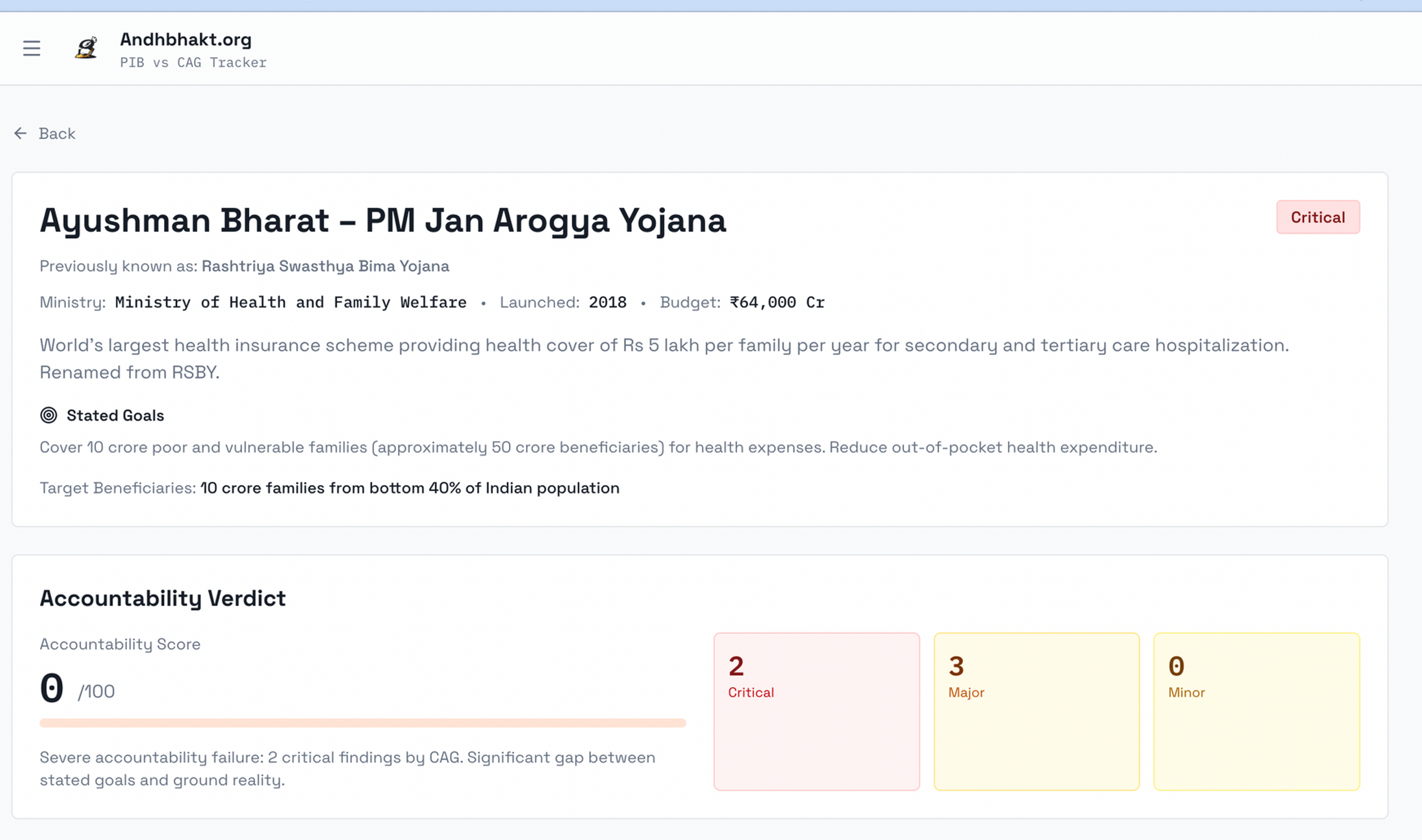
In the portal, he lists major GOI schemes and compares them with CAG reports auditing their implementation. I scrolled through the page and got alarmed by CRITICAL rating given to almost all the schemes. Just out of curiosity, I went to Ayushman Bharat (GOI’s flagship insurance scheme which has an accountability score of 0 on the portal) and found out that this national scheme had been given a bad rating, while citing a CAG report from GOA, and even that report was referenced inaccurately.
So I pointed it out to Mr. JC, and he promptly updated the portal and removed that citation (good job!). But still, if you look at Ayushman Bharat Scheme, the reading on the portal is CRITICAL, the accountability score still 0; with the current citations just as superficial, and their interpretations still totally incorrect and misleading. Everything is so wrong that it’s basically libel. Let’s dive in.
The portal quotes a CAG report from 2023 and says:
“Claimed: 10 Cr families covered | Actual: 2.95 Cr families with active cards | Gap: 70.5%”
1. 10 Cr families was the target, not a “claim”.
2. The “2.95 Cr families active cards” number on the portal is an absolute fabrication and LIE. It’s nowhere in the report being cited. In fact, the report itself says 7.87 Cr families got the card, implying a coverage of 73%.
3. Lastly, even if the CAG report’s basic reading was correct (which it isn’t), the 2023 report is itself quite old, and the portal doesn’t acknowledge the steps taken after it. So if this portal
wasn’t totally wrong (which it is), it’d definitely be outdated, and thus useless.
This is what I told him in the comments as well:
“It's not about CAG reports not being organised in a proper manner. That's the least of the problems here. This is a design problem. This tool is taking cherry picking and hallucinating to forcefit a particular thesis to Olympic extremes.To begin with, CAG is not the only source to measure a scheme anyway. CAG alone is slow, uneven, and easy to misquote. People think it measures all schemes equally, but actually, only some get dedicated performance audits, many only appear inside broader ministry reports. A proper way to measure a scheme would involve triangulation of budget, ministry MIS, beneficiary delivery (through DBT or otherwise), utilization, outcomes, AND THEN compliance audits (central/state CAG) and surveys. CAG is only one of the six lanes. CAG alone (or CAG-vs-PIB-only) is a terrible backbone for such a product. I'll build something and get back to you.”
Now notice what he says to me:
“CAG is actually the one way to cross verify if the govt is lying through its teeth or not. You can have a perfect budget, perfect utilisation, and even x numbers of toilets constructed but only a audit can tell you that 98% toilets didn’t have water or that more than 50% of them were being used as storerooms because they weren’t functional.”
And with that, he shared a screenshot of a 2021 CAG survey report done in 8 rural districts in Odisha and said:
“Does it prove the point that PIB data can’t be taken on face value? Yes. It contrasts the govt claims it made during the time.”
To that, I gave my final reply:
“The report is old. That was my point. The snapshot you've just shared pertains to a CAG inspection in the 8 sampled rural districts of in Odisha, in 2021. And you're using it to frame your argument for the entire India, and in 2026. You see the extrapolation problem?This is why I said CAG reports can't be the only source. They are uneven, and have really high latency. Since that inspection in 2021, the Government of Odisha responded in late 2022 that they would fix this via convergence with the Jal Jeevan Mission (JJM) and the state's BASUDHA scheme.Since then, they managed to bring a drastic rise in rural tap water connectivity. From 3.5% in 2019, rural household tap water connectivity surged to 77.1% in 2025. CAG will report on this a few years later.
You are extrapolating a 6 year old field study conducted in 8 rural districts of Odisha to the entire country. And calling a challenge to it irrelevant.And “data” comes with a context and expiry date. How can a particular piece of data be taken as complete while making an accusation on the progress of an effort, when it's 6 years old, limited to a particular geographry and can't incorporate progress made after it? The government claimed construction of toilets, hence freedom from open defacation. Tap water is a separate subject which the state government of Odisha began working on in 2019 (and addressed your CAG report in 2022 itself). By the way, I don't think anyone will appreciate if I talk about AI literacy, and quote a 2020 report. No offense intended, none taken. I'll try and build on this and announce it soon. Cheers.”
Despite all that correspondence, when I’m looking at the portal right now, I see no attempts to fix the mistakes in any way possible. It’s still peddling falsehoods in full verve and gusto, and without any shame. The only thing that has probably changed is that it now has a legal disclaimer, perhaps to save itself from defamation cases that can (and should) follow.
Some of my well wishers even told me to mellow down my words in this article. But I don’t think that would be right. Here’s someone who is critising the government’s for lack of accountability (as he should), but himself falling prey to faux intellectualism and hallucinated “data”. And despite being politely pointed out the flaws in his methodology, he’s not changing course because it doesn’t suit his political slant. He’s a resourceful person unleashing a wave of misinformation, and it’s all being lapped up by a certain crowd.
This is no small matter. This needs to be responded to with full honesty and integrity. This is
no invite a conflict with Mr. Jitendra Chouksey or anyone. But the truth is worth fighting for.
By the way, here’s the reading of Ayushman Bharat by Mr. Jitendra Chouksey:
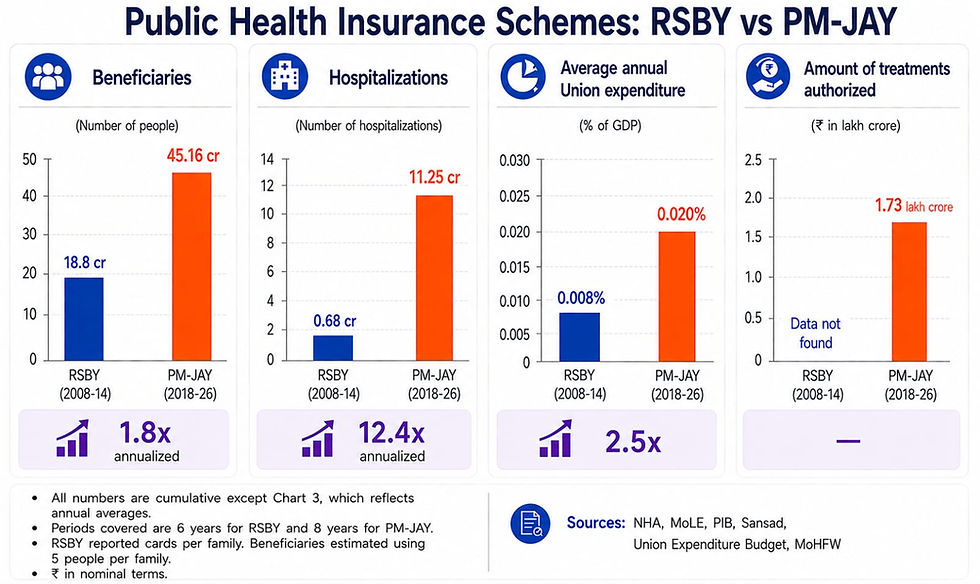
And here’s an actually relevant, truthful graph comparing PMJAY w/ its predecessor. Apple to apple. It was researched on and created by Ms. Chavi Jain.
P.S. My company builds Voice Agents for businesses to help them acquire, engage and retain customers through calls. It’s working incredibly well! If this seems interesting, reach out and we’ll talk! :)


Comments